


If you have worked in a pharmaceutical microbiology laboratory or performed environmental monitoring in a cleanroom, you have probably come across agar plates with visible cracks.
At first glance, these cracks may appear harmless. Many analysts assume they are only cosmetic defects that do not affect the test.
However, cracked agar plates often indicate that the medium has lost moisture, and that change can influence microbial recovery, media performance, and more importantly, the reliability of environmental monitoring results.
Agar desiccation remains one of the most common quality issues observed during the storage and use of prepared culture media. It can occur in settle plates, contact plates, and other prepared agar media when storage conditions are not ideal or when plates remain exposed to the environment for extended periods.
Understanding why agar cracks, what it means, and how to prevent it helps microbiology laboratories maintain the quality of their environmental monitoring program and avoid unnecessary investigations.
What Is Agar Desiccation?
Agar desiccation refers to the gradual loss of water from solid culture media. As moisture evaporates, the agar gel begins to shrink. Because the plastic Petri dish does not shrink along with the medium, mechanical stress develops within the agar. Eventually, the surface or the entire agar layer splits, producing visible cracks.
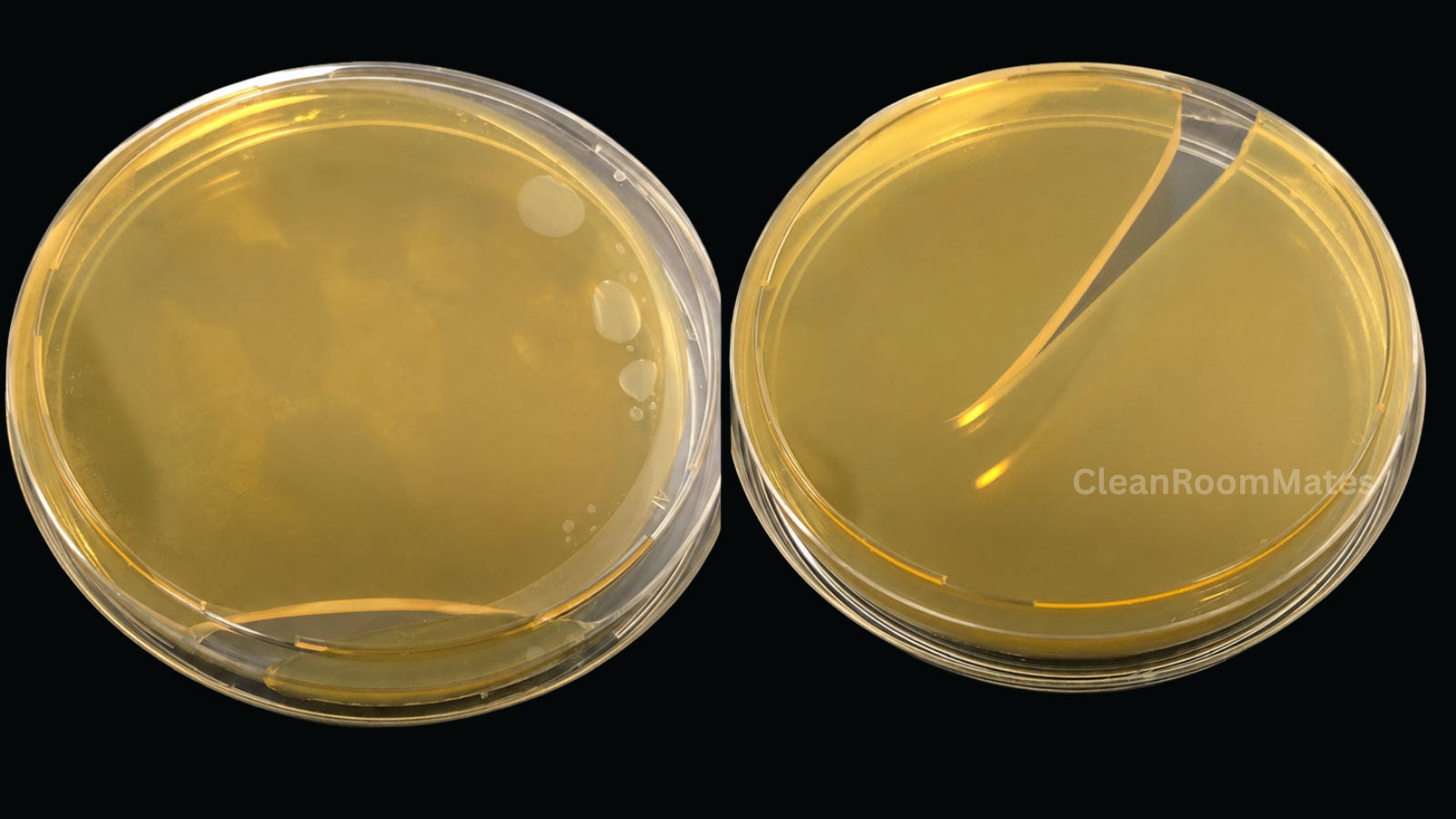
These cracks are not caused by contamination or microbial growth. They result from physical changes within the medium due to dehydration.
In pharmaceutical microbiology laboratories, agar desiccation most commonly affects prepared media that remain in storage for prolonged periods or plates exposed to dry airflow during environmental monitoring.
Why Do Agar Plates Crack?
The primary reason behind agar cracking is moisture loss. Agar is a hydrogel that contains approximately 95–97% water. This water maintains the gel’s flexibility and provides the moist environment necessary for microbial recovery and growth.
Several factors accelerate this process.
1. Prolonged Storage
Time is one of the biggest contributors to agar desiccation. Even when agar plates remain sealed in their original packaging, a very small amount of water slowly diffuses through the packaging material over time. Although this moisture loss occurs gradually, it becomes significant as the storage period increases.
Manufacturers establish expiry dates after conducting stability studies that evaluate the physical appearance, pH, sterility, growth promotion characteristics, and moisture content of the prepared media.
Older plates often show visible signs of dehydration before they expire. Laboratories that fail to rotate media stock properly frequently encounter this problem.
Using the First In, First Out (FIFO) inventory system helps minimize the use of aging media and reduces the risk of desiccation-related defects.
2. Improper Storage Temperature
Prepared media should remain within the manufacturer’s recommended storage temperature, which is commonly between 2°C and 8°C for most commercially prepared microbiological media. Higher temperatures increase the rate of water evaporation from the agar surface.
Storing plates outside the recommended range for prolonged periods accelerates dehydration, even when they remain unopened.
3. Airflow During Environmental Monitoring
This is one of the most common causes of agar cracking in pharmaceutical cleanrooms.
Settle plates remain uncovered for extended periods during environmental monitoring. Grade A and Grade B cleanrooms operate with continuous HEPA-filtered airflow that removes airborne particles and maintains contamination control.
Unfortunately, this same airflow continuously removes moisture from the exposed agar surface.
The longer the exposure time, the greater the water loss becomes. Plates exposed for four hours under unidirectional airflow may lose considerably more moisture than plates stored under normal laboratory conditions.
In areas with very high airflow velocities, desiccation becomes even more common.
Although exposure times comply with environmental monitoring procedures, excessive drying may still occur if media quality, airflow conditions, and exposure duration are not properly balanced.
Laboratories must validate the 4-hour exposure time and evaluate the loss of moisture, loss of weight, and growth promotion capabilities.
4. Incubator Conditions
Microbiological incubators operate at temperatures that encourage microbial growth, but warm air naturally increases evaporation from the agar surface.
During incubation, plates are usually inverted to prevent condensation from dripping onto colonies. While inversion protects colony morphology, moisture continues migrating through the agar and eventually escapes into the incubator atmosphere.
If incubator humidity is very low or incubation extends beyond validated periods, the agar may become noticeably drier before colony counting.
5. Thin Agar Layer
The depth of the agar directly influences its ability to retain moisture.
A thinner agar layer contains less water and therefore dries much faster than a standard plate. Even under similar storage conditions, thin media may develop cracks sooner simply because there is less moisture available.
Uneven pouring can produce localized thin areas that crack before the rest of the plate.
Commercial media manufacturers strictly control agar volume for precisely this reason.
Companies can customize the agar volume according to their needs.
6. Temperature Fluctuations
This factor often goes unnoticed.
Every time a refrigerator door opens, warm room air enters while cool air escapes. The resulting temperature fluctuations increase condensation and accelerate moisture migration from stored media.
Busy microbiology laboratories that access media refrigerators several times each day may unknowingly shorten the usable life of prepared agar.
Dedicated media refrigerators and minimizing unnecessary door openings help preserve media quality.
7. Mechanical Stress
Cracks do not always originate from desiccation alone.
Environmental monitoring performed inside isolators presents unique challenges for agar plates. Unlike conventional cleanrooms, isolators operate with a highly controlled environment and continuous HEPA-filtered airflow. Many isolators also maintain low humidity and positive pressure to preserve aseptic conditions.
Laboratories often observe that agar plates exposed inside isolators show greater desiccation than plates used in conventional Grade B or Grade C environments, even when the exposure time is the same.
In pharmaceutical manufacturing facilities, vibrations may originate from equipment such as filling machines, capping machines, conveyors, tablet compression machines, centrifuges, HVAC systems, vacuum pumps, compressors, or other rotating machinery.
During transportation, agar plates may also experience vibration from vehicles.
Is Agar Desiccation A Problem?
Yes. Excessive desiccation can reduce the effectiveness of environmental monitoring.
Microorganisms require adequate moisture to survive after landing on the agar surface. A dry medium creates a less favorable environment for stressed environmental microorganisms.
When the agar loses significant moisture:
Recovery efficiency may decrease.
Slow-growing organisms become more difficult to recover.
Injured microorganisms may fail to grow.
Colony morphology may appear abnormal.
Enumeration may become less reliable.
The result may be an underestimation of microbial contamination rather than a true reflection of cleanroom conditions.
For pharmaceutical manufacturers, this creates a serious data quality concern because environmental monitoring supports contamination control decisions and batch releases.
Should You Consider Every Crack?
Not necessarily.
A small superficial crack does not automatically invalidate an environmental monitoring result. Laboratories should evaluate the extent of desiccation using predefined acceptance criteria established during media qualification or quality procedures.
The decision should consider factors such as:
The size and number of cracks
Whether the agar surface remains intact
Loss of contact between agar sections
Degree of shrinkage
Media manufacturer’s recommendations
Internal laboratory procedures
Many laboratories reject plates showing severe desiccation because excessive moisture loss may compromise microbial recovery.
How Can You Prevent Agar Plate Cracking?
Preventing desiccation starts with proper media handling throughout the entire lifecycle of the agar plate.
Always store prepared media according to the manufacturer’s recommended temperature range. Avoid unnecessary exposure to room temperature before use.
Keep plates inside their original sealed packaging until required. Once opened, minimize the time before use.
Rotate stock using the First-In, First-Out (FIFO) principle so that older media does not remain in storage longer than necessary.
During environmental monitoring, expose settle plates only for the validated duration defined in the monitoring program. Avoid unnecessary delays before incubation.
Handle plates gently to prevent additional physical stress on partially dried agar.
Monitor refrigerators regularly to verify temperature compliance and minimize repeated warming cycles caused by excessive door opening.
When preparing media in-house, maintain consistent agar depth during pouring and validate media preparation procedures.
Routine visual inspection before use should become part of every microbiology laboratory’s media acceptance process. Plates showing obvious shrinkage, severe cracking, discoloration, contamination, or dehydration should not be used unless laboratory procedures specifically permit their use following documented evaluation.
Why Do Some Manufacturers Add Glycerol?
Even though glycerol is primarily added to certain culture media as a carbon and energy source for microbial growth, some manufacturers add glycerol to prepared culture media to help reduce agar desiccation. Glycerol is a humectant that attracts and retains water, therefore slows moisture loss from the agar during storage, transportation, and environmental monitoring.
By maintaining the moisture content, glycerol helps keep the agar flexible, reducing shrinkage and the chances of cracking. This can be particularly beneficial for media exposed for extended periods in cleanrooms, isolators, or other high-airflow environments.
However, glycerol is not added to all culture media. Manufacturers carefully optimize its concentration to improve moisture retention without affecting the microbiological performance of the medium.
Why Do Some Agar Plates Crack Only After Incubation?
Sometimes, agar plates appear normal before and after environmental monitoring but develop visible cracks only after incubation. This does not necessarily mean that the incubator caused the cracks.
During environmental monitoring, especially in cleanrooms or isolators, the exposed agar gradually loses moisture. Although this initial dehydration may not produce visible cracks, it weakens the agar gel. During incubation, the elevated temperature promotes further moisture loss and causes the agar to shrink. As the agar contracts while the rigid Petri dish remains unchanged, internal stress builds until the gel eventually cracks.
Therefore, cracks observed after incubation are often the result of progressive agar desiccation that began during storage or environmental monitoring and became visible only after incubation.
When investigating such observations, laboratories should evaluate the entire lifecycle of the agar plate, including storage conditions, media age, exposure duration, airflow, and incubation conditions, rather than attributing the cracks solely to the incubation process.
Should Cracked Agar Plates Trigger an Investigation?
If cracked agar plates appear occasionally, the laboratory should first determine whether the condition falls within established acceptance criteria.
However, repeated occurrences deserve investigation because they may indicate underlying process issues.
Potential causes include inadequate storage practices, poor stock rotation, refrigerator temperature excursions, prolonged environmental monitoring exposure, supplier quality problems, or improper media handling.
A Technical Note
From a scientific standpoint, I would rank the causes like this:
Primary causes (directly cause agar desiccation):
Prolonged storage
Improper storage temperature
Low humidity
High airflow (cleanrooms, LAFs, isolators, RABS)
Long exposure times
Thin agar depth
Inadequate packaging
Secondary contributing factors (promote / worsen cracking):
Mechanical vibration
Rough handling during transport
Manufacturing defects
Improper media preparation