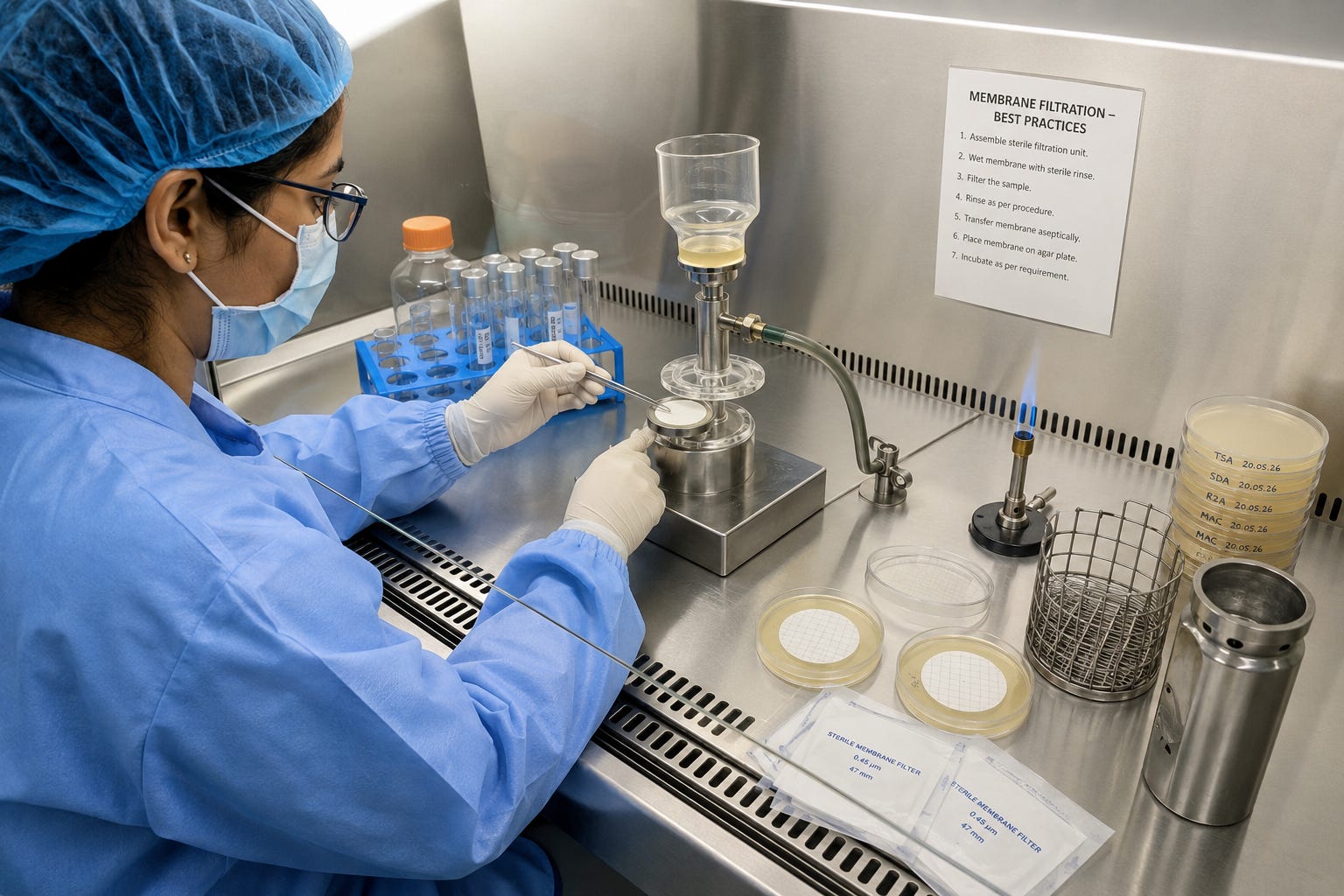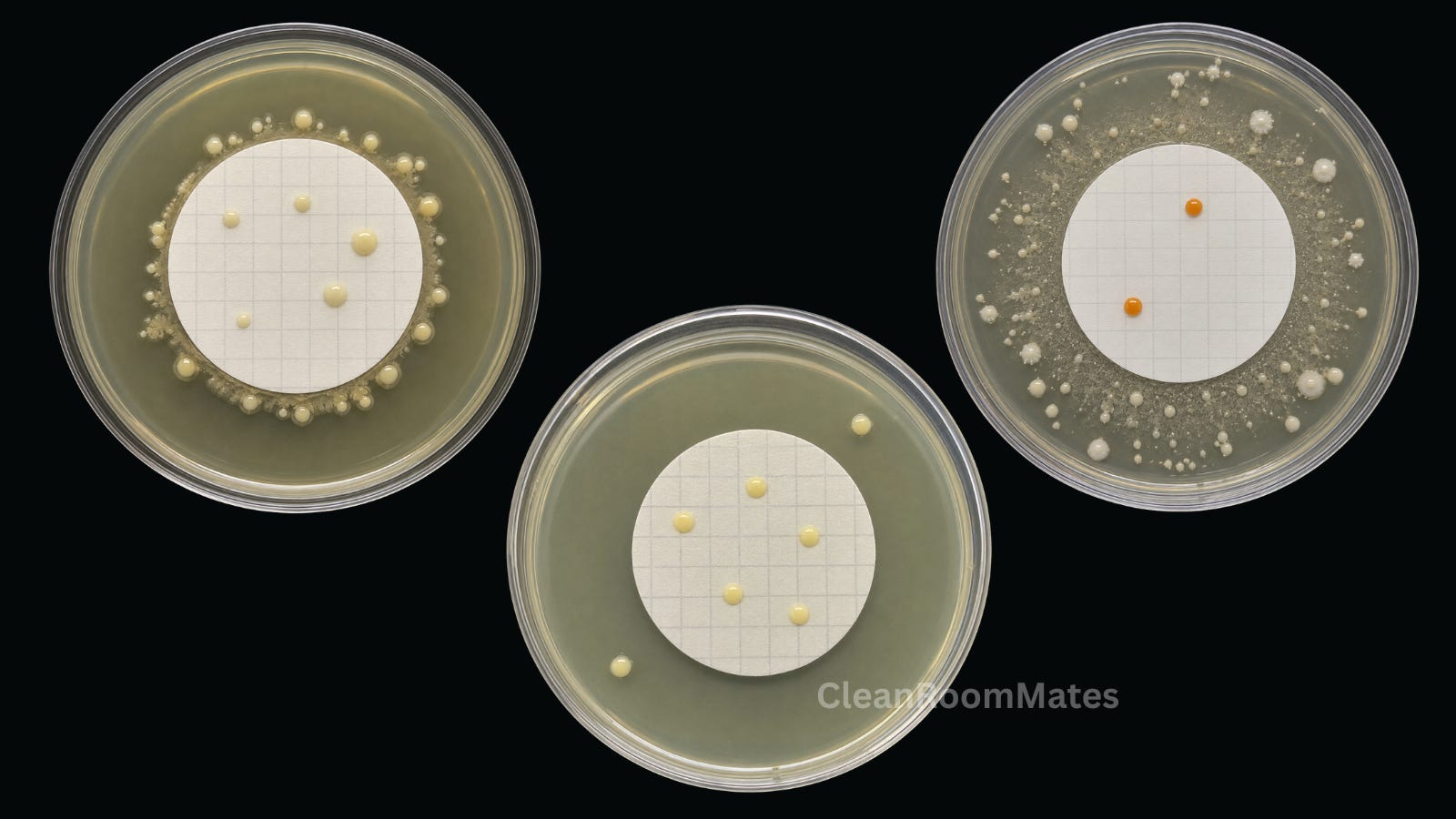
If you are a microbiologist, you have probably encountered a membrane filtration plate with one or more colonies growing outside the membrane filter.
It is one of those situations that immediately catches the analyst’s attention.
The first question that comes to mind is simple: Should I count this colony?
Colonies growing on the membrane filter do not create confusion because they represent microorganisms retained during filtration.
The challenge begins when a colony appears on the agar surface outside the membrane. At that point, the analyst must determine whether the microorganism originated from the sample or entered during the filtration process.
This situation often leads to investigations, discussions with quality assurance, and sometimes even repeat testing.
Why do colonies grow outside the membrane filter?
The membrane retains microorganisms present in the sample, and after filtration, the membrane is placed directly onto culture media where the retained microorganisms grow into visible colonies.
Ideally, every colony should develop on the membrane surface.
When colonies appear beyond the membrane edge, something has happened after or during filtration that allowed microorganisms to reach the surrounding agar.
In many cases, the product itself is not responsible.
The explanation often lies in the handling technique.
Membrane movement during transfer
The most common reason for outside colonies is slight movement of the membrane while transferring it from the filtration assembly to the agar plate.
After filtration, the membrane remains wet. If the analyst slides the membrane instead of placing it gently onto the agar, microorganisms located near the edge can move onto the exposed agar surface. Even a very small shift can transfer cells beyond the membrane boundary.
Excess moisture can carry microorganisms
Water is another cause for transporting microorganisms.
If excess rinse solution remains on the membrane, forceps, or agar surface, microorganisms can move along with the liquid beyond the membrane edge before incubation begins.
Condensation inside Petri dishes can create the same problem. A single droplet falling from the lid may spread microorganisms across the agar, producing colonies that appear unrelated to the membrane.
Improper handling with forceps
Forceps can be one of the most overlooked sources of contamination.
An analyst may unknowingly touch the agar surface, the edge of the filtration unit, or another non-sterile surface before transferring the membrane. Any microorganism present on the forceps can easily transfer directly onto the culture medium outside the membrane.
Airborne contamination
Even inside a well-qualified laminar airflow cabinet, poor aseptic practices can introduce contamination.
Frequent hand movements, unnecessary talking, improper placement of materials, or prolonged exposure of agar plates all increase the opportunity for airborne microorganisms to settle on the media.
Most laboratories maintain excellent environmental conditions, but technique always remains the most important factor.
Should outside colonies be counted?
This question is debatable in pharmaceutical microbiology laboratories.
Pharmacopoeias do not provide a simple instruction stating that every outside colony must always be counted or rejected. Instead, they expect laboratories to establish scientifically justified procedures that define how such observations will be evaluated.
Most laboratories count colonies growing entirely on the membrane because they clearly represent microorganisms retained during filtration.
Colonies that extend slightly across the membrane edge often receive careful evaluation. When the growth pattern clearly demonstrates that the colony originated on the membrane, many laboratories include it in the count with appropriate scientific justification.
Colonies growing completely outside the membrane deserve investigation before any reporting decision. The laboratory should avoid making assumptions and instead follow its approved procedure consistently.
Consistency matters as much as the technical decision itself. Regulatory inspectors expect laboratories to apply the same scientific rationale every time rather than making different decisions for similar observations.
What should an investigation include?
A complete investigation should examine the entire testing process instead of focusing only on the colony.
The laboratory should review analyst technique, filtration records, membrane transfer practices, environmental monitoring results, negative controls, equipment qualification, media quality, and incubation conditions. If necessary, organism identification may provide additional evidence regarding the likely source of contamination.
Build a strong laboratory procedure
Every microbiology laboratory should define a clear approach for handling colonies outside the membrane.
The procedure should explain…
How analysts inspect membrane plates
How outside colonies are classified
When investigations become necessary
Who makes the final reporting decision
When organism identification should be performed
Clear documentation protects both the analyst and the laboratory. More importantly, it ensures that every similar observation receives the same scientific evaluation.
Ultimately, microbiological testing is not only about counting colonies. It is about understanding how they arrived there in the first place.