


A cleanroom may have an excellent HVAC system, HEPA filters, pressure differentials, and a well-designed environmental monitoring program.
Yet one poorly controlled entry and exit can still introduce contamination.
Why?
Because people remain one of the most significant sources of particles and microorganisms inside a cleanroom.
Every movement matters. Opening a door, changing garments, touching a surface, putting on gloves, walking across a clean area, or leaving the room can affect the contamination-control state of the facility.
That is why cleanroom entry and exit should never become routine activities that people perform mechanically.
Personnel need to understand why each step exists, not simply memorize the sequence.
EU GMP Annex 1 emphasizes personnel movement and gowning as important elements of contamination control. It also expects appropriate personnel airlocks and controlled movement between areas of different cleanliness grades.
WHO GMP guidance similarly describes airlocks as a means of providing physical separation and minimizing microbial and particulate contamination between areas.

Why is cleanroom entry so important?
The moment a person enters a cleanroom, the person becomes a potential source of contamination.
Human skin continuously releases particles. Hair and skin flakes can carry microorganisms. Clothing can carry fibres and particles from the surrounding environment. Hands can transfer microorganisms to surfaces. Even normal activities such as walking, talking, bending, or adjusting garments can increase particle generation.
The objective of a cleanroom entry procedure is therefore not simply to make the person “clean.”
The objective is to reduce the contamination carried by the person before the person reaches the controlled area.
This distinction is important.
A person does not become sterile by wearing a cleanroom gown.
Instead, appropriate gowning creates a controlled barrier between the person and the cleanroom environment.
Cleanroom entry starts before the gowning room
Good cleanroom behavior begins before personnel reach the cleanroom.
Personnel should report to work in a condition that supports contamination control.
Personal hygiene, appropriate clothing, controlled use of cosmetics and jewellery, and compliance with site-specific requirements all contribute to the overall contamination-control strategy.
Personnel should also avoid bringing unnecessary items into controlled areas.
Mobile phones, keys, wallets, watches, pens, notebooks and other personal belongings can introduce particles and microorganisms. They may also create additional surfaces that personnel touch repeatedly.
A well-designed facility therefore provides designated locations for personal belongings before personnel enter controlled areas.
The exact requirements will depend on the cleanroom classification, product, process and site contamination-control strategy.
The role of the personnel airlock
The personnel airlock provides a controlled transition between areas with different cleanliness levels.
Think of it as a buffer zone rather than simply a passageway.
For example, personnel may move progressively from a less clean area to a cleaner area through a sequence such as:
Unclassified area → Grade D → Grade C → Grade B
The actual arrangement depends on the facility design and process requirements.
The airlock helps maintain separation between environments, but it cannot compensate for poor personnel behavior.
If someone opens both doors simultaneously, ignores the gowning sequence, touches clean garments with contaminated hands, or rushes through the airlock, the airlock loses much of its intended value.
One door at a time
This sounds simple, but it is fundamental.
Personnel should not open the next door until the previous door has closed.
Interlocking systems commonly prevent both doors of an airlock from opening simultaneously.
The purpose is to maintain the intended separation between areas.
If two doors remain open at the same time, uncontrolled air movement can occur. Particles and microorganisms can also move between areas.
The gowning sequence matters
Gowning should follow a defined sequence.
The sequence should progressively reduce the risk of transferring contamination from the person, personal clothing and less-clean garments to the cleanroom garments.
A gowning process may involve changing from personal footwear to dedicated footwear, removing outer clothing, performing hand hygiene, donning head and facial coverings, putting on cleanroom garments, and finally putting on gloves.
The exact sequence depends on the facility and the cleanroom grade.
What matters most is that the sequence prevents already-cleaned or sterilized garments from becoming contaminated during subsequent steps.
For example, if a person puts on clean gloves and then touches a potentially contaminated surface, the gloves are no longer in the same contamination state.
This is why experienced operators develop a habit of thinking about what is clean and what is not clean throughout the gowning process.
The cross-over bench has a purpose
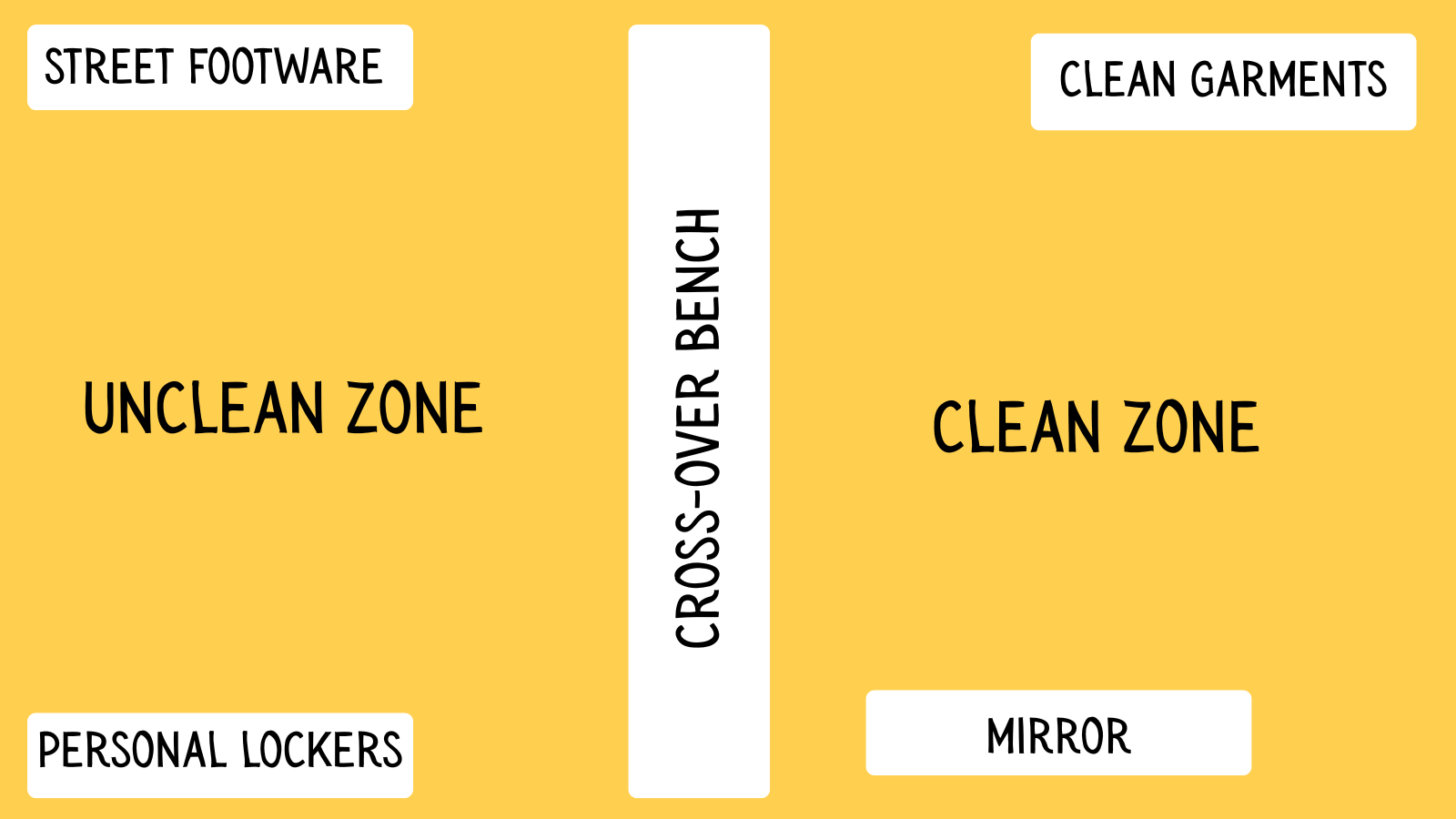
Many pharmaceutical facilities use a cross-over bench in the changing room.
The bench creates a physical boundary between the outer and clean sides of the changing area.
Personnel should sit or turn appropriately when changing footwear so that the clean side does not become contaminated by contact with the outer footwear or floor.
It is easy to treat the bench as just another piece of furniture.
It is not.
It forms part of the contamination-control design of the changing room.
Hand hygiene before entering
Hands deserve special attention because they frequently touch surfaces and garments.
Personnel should perform hand hygiene according to the approved procedure before proceeding into the cleaner area.
The site procedure may specify washing, drying and/or sanitization depending on the area and process.
However, applying disinfectant to visibly dirty hands does not replace proper cleaning.
Personnel should also avoid touching unnecessary surfaces after sanitizing their hands.
A common mistake is to sanitize the hands and immediately touch the door handle, or another contaminated surface.
The operator then has to repeat the hand hygiene step.
Putting on the cleanroom gown
Cleanroom garments should be handled carefully.
The operator should avoid allowing the garment to touch the floor, walls, dirty surfaces or personal clothing.
Garments should also be donned in a way that minimizes unnecessary manipulation.
The cleanroom garment should cover the clothing and exposed body surfaces according to the requirements of the area.
For higher-grade areas, the gowning system becomes increasingly important because the contamination risk becomes increasingly critical.
Gloves are not a substitute for hand hygiene
This deserves emphasis.
Putting on gloves does not make contaminated hands clean.
Gloves themselves can become contaminated during handling. The operator should therefore follow the site’s approved hand hygiene and glove sanitization practices.
Once gloved, personnel should avoid touching unnecessary surfaces.
Door handles, face masks, spectacles, hair, and other objects can become sources of glove contamination.
If an operator touches a non-controlled surface with clean gloves, the operator should follow the site procedure for addressing the situation.
Minimize movement inside the cleanroom
Entering correctly is only half of the story.
Once inside, personnel should move deliberately.
Fast movement creates more turbulence and can increase particle dispersion. Unnecessary walking also increases the number of particles generated by the operator.
Personnel should avoid unnecessary movements such as repeated walking in and out, frequent bending, unnecessary conversations, and repeated adjustment of garments.
The principle is simple:
Move only as much as the operation requires.
Touching surfaces
Every surface inside a cleanroom has a contamination-control significance.
Personnel should avoid unnecessary contact with walls, doors, equipment surfaces, furniture and other structures.
A person may unknowingly transfer contamination from gloves to a surface. Another person may then touch the same surface.
This creates a chain of contamination transfer.
Good cleanroom behavior breaks that chain.
What if you need to return to the cleanroom?
This situation occurs frequently.
An operator exits the cleanroom and then realizes that a document, instrument, sample or other item remains inside.
The temptation is to turn around and go back immediately.
That is where discipline becomes important.
The person should repeat the applicable entry procedure rather than treating the second entry as a continuation of the previous one.
If the gowning procedure requires removal and re-donning of garments, the operator should follow the approved procedure.
“Just going back for one minute” should never become an informal exception.
Common cleanroom entry and exit mistakes
Most cleanroom contamination-control failures do not necessarily involve dramatic mistakes.
They often involve small shortcuts repeated every day.
Someone leaves a door open while talking to a colleague.
Someone touches their face with clean gloves.
Someone carries a mobile phone into an area where it does not belong.
Someone wears a cleanroom garment outside the designated area.
Someone walks quickly because they are late.
Someone enters without following the complete gowning sequence because they have “done it hundreds of times.”
Individually, these actions may appear insignificant.
Collectively, they can weaken the contamination-control system.
Why training matters
A cleanroom procedure cannot depend entirely on written instructions.
Personnel need practical training.
New operators should understand the gowning sequence, airlock behavior, hand hygiene, movement restrictions, garment handling and exit procedure before they work independently.
Training should also include practical demonstration and assessment.
The operator should be able to demonstrate the procedure correctly, not simply sign a training record.
Periodic refresher training helps reinforce good behavior.
Because human behavior changes with time, supervision and observation also have an important role.
What should an entry and exit SOP contain?
A good SOP should clearly describe the applicable entry and exit routes, responsibilities, gowning sequence, hand hygiene requirements, airlock behavior, garment handling, movement restrictions and actions for abnormal situations.
It should also define what personnel should do when they accidentally touch a contaminated surface, drop a garment, open the wrong door, leave the cleanroom unexpectedly or discover a problem with their gown.
The procedure should answer a simple question:
What should the operator do when something does not go according to plan?
The human factor in cleanroom contamination control
Technology can control airflow.
HEPA filters can remove particles.
Pressure cascades can control airflow direction.
Airlocks can provide physical separation.
Cleaning and disinfection can reduce contamination.
But people operate the system.
That makes human behavior one of the most important parts of contamination control.
The best cleanroom procedure is not necessarily the longest one. It is the one that personnel understand, can perform consistently, and can follow without confusion.
A simple way to remember cleanroom entry and exit
Before entering, think:
Prepare → Change → Clean → Gown → Check → Enter
Before leaving, think:
Stop → Exit systematically → Remove garments correctly → Dispose or segregate → Leave through the designated route
Your actual SOP may contain more steps, and it should always take precedence.
The important principle remains the same: never allow personnel movement to become an uncontrolled pathway for contamination.